Reward Package
Reward service, backends, scorers, and the reward extension workflow.
Where it fits: the reward step of the loop — rollout → reward → advantage → train → sync. In: the rollout engine's response
Sample. Out: per-sample rewards (which the trainer turns into advantages). Full map:../README.md.
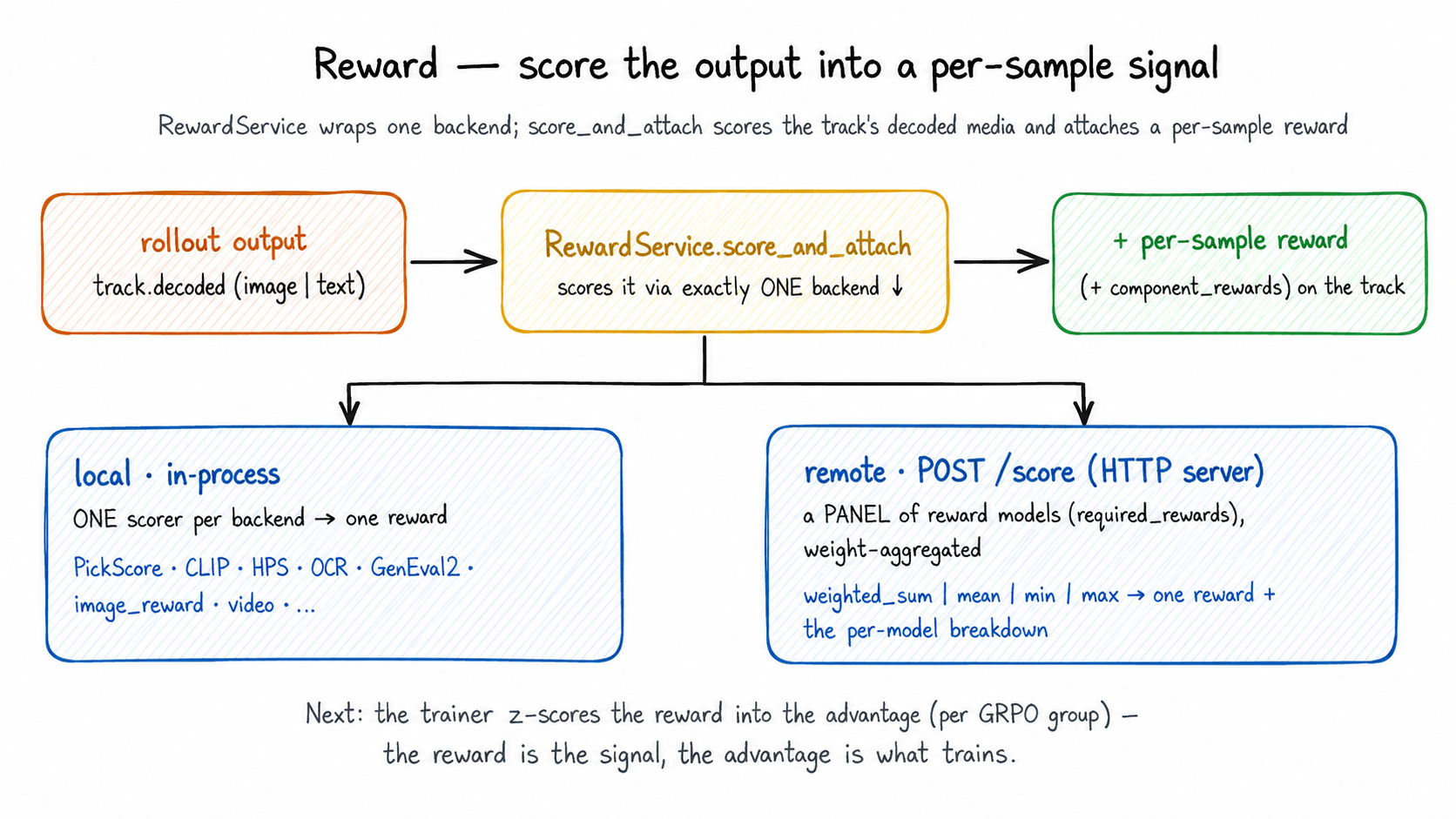
One RewardService wraps one backend: a single in-process scorer (local) or a remote HTTP server that runs and weight-aggregates a panel of reward models. The per-sample reward it attaches is what the trainer z-scores into the advantage.
What it is
unirl.reward scores what a rollout produced — an image, a video, or text — and
writes a per-sample reward back onto the Sample's frontier Part. A RewardService wraps
exactly one RewardBackend: either a local in-process scorer (PickScore, HPS,
CLIP, OCR, GenEval2, math, multiple-choice, video, …) or RemoteRewardBackend, a
thin HTTP client for the standalone server in unirl-reward-service/.
Turning rewards into advantages is the trainer's job
(Part.compute_advantages); generating the media is the rollout engine's.
Local scorer registry
The canonical built-in names are the keys in
local/registry.py. VideoRewardScorer resolves its
inner_model_name through the registry; recipes otherwise instantiate the
listed scorer classes directly with Hydra _target_.
| Registry key | Input | Purpose and restrictions |
|---|---|---|
aesthetic | image | Registered placeholder; model loading and scoring are not implemented. |
clip | image | CLIP prompt-image similarity. |
geneval2 | image + evaluation questions | Local Qwen3-VL Soft-TIFA scorer; vqa_list comes from row metadata or a configured dataset file; rows with neither score 0. |
hpsv2 | image | HPS v2 prompt-image preference. |
hpsv3 | image | HPS v3 prompt-image preference. |
hpsv3pp | image | HPSv3++ scorer; requires its source checkout/config and accepts a local or Hugging Face-hosted checkpoint. |
image_reward | image | ImageReward prompt-image preference. |
ocr | image | OCR similarity against the quoted target span in the prompt. |
pickscore | image | PickScore prompt-image preference. |
videopickscore | video | PickScore on one configured representative frame. |
videoclipdelta | video + condition video | Prompt alignment minus similarity to the source video; V2V only. |
videoalign | video | Vendored VideoAlign prompt-video scorer. |
mc_exact_match | text + metadata | Multiple-choice answer match against metadata.answer; rows without it score 0 rather than raising. |
clap | generated audio/video | CLAP prompt-audio alignment for T2AV output; requires the generated audio and its sample rate. |
imagebind | generated audio/video | ImageBind audio/video/text alignment; noncommercial upstream license. RewardService rejects it for training unless mode is text_video or all with a positive text_video weight (override with require_prompt_video: false). |
t2av_composite | generated audio/video | Weighted composition of video-capable inner scorers; rejects a mix without a positive prompt-video term. |
per_domain | image + metadata | Routes rows by metadata.domain to configured inner scorers. |
MathVerifyRewardScorer (math_verify) and LLMJudgeRewardScorer
(llm_judge) are valid direct recipe targets but are not entries in the
built-in registry. VideoRewardScorer is a wrapper whose
inner_model_name must resolve through the registry; it is not a registry key
itself. The standalone HTTP service has a separate registry and deployment
matrix in ../../unirl-reward-service/README.md.
Why it exists
RL is only as good as its reward signal, and two things about that signal are easy to get wrong — so this module owns both:
- One interface over many scorers. Local or remote, image/video/text, the
trainer always calls the same
score_and_attach(sample)and never touches a backend. Swapping PickScore for a remote multi-reward server is a recipe change, not a code change. - A bad reward must stop the step, not poison it. A single NaN, null, or failed inference call would silently skew a whole GRPO group's advantages. The service fails loud: any non-finite or missing reward raises instead of flowing into training.
How it works
Everything goes through one method, RewardService.score_and_attach(sample)
(service.py). It runs per DP shard (sharding the Sample by prompt-tree), so it
never mutates the input Sample — it returns a fresh one. Per call it:
- Refuses precomputed rewards — raises if the frontier Part already has
rewards(actor-side scoring is the only writer). - Builds the request — pairs the frontier's generated media with its aligned prompts and non-text conditioning.
- Scores — hands a typed
RewardRequesttobackend.compute_rewards, getting back rewards, per-component rewards, and per-sample success flags. - Fails fast — raises and names the sample if any failed.
- Applies the AR truncation policy — only when the scored Part is a
variable-length AR generation (fixed-length AR media such as Janus-Pro image
tokens always reaches
max_new_tokensand keeps its reward).truncated_reward: zero(default) assigns reward 0 to a trace that hitmax_new_tokens,keeppreserves the scorer result, andsoftadds a penalty that grows linearly over the lastoverlong_buffer_lentokens, scaled byoverlong_penalty_factor. - Attaches
rewards+component_rewardsand returns the Sample.
A backend is just compute_rewards(request) -> RewardResponse. Local scorers
(local/) subclass LocalRewardBackend and implement _compute_model_rewards;
the remote backend (remote.py) sends one or more bounded POST /score calls,
multiplexes every requested reward in each item, and derives success from the
merged response.
Micro-batching the rollout so a remote reward overlaps generation
RewardStack (stack.py) is an optional role for the diffusion training path, built
beside the rollout engine on the same Worker. Given one DP shard it slices the frontier
Part into micros of micro_batch_size rows, generates
and scores each micro in-process through its rollout and reward siblings, and
concatenates the scored Parts back into one Sample. The driver then skips
_reward_phase().
reward_stack:
  _target_: unirl.reward.stack.RewardStack
  micro_batch_size: 8      # rows per micro; a micro can be one row unless the engine packs whole groups
  overlap: false           # true: score each micro on a thread while the next ones generate
A micro can be as small as one row. The exception is an engine that packs a whole
samples_per_prompt group into one request (the vLLM-Omni t2i adapters: SD3, Qwen-Image
and BAGEL t2i), which the engine reports through packs_groups(sample); there a micro is
extended to the end of the group it would otherwise split, so the group is the floor.
BAGEL it2i, SGLang and the trainside engine take micros of any size.
It pays for a reward that costs real time relative to generation, which in practice
means one served from other GPUs: colocated with PickScore the stack recovers 0.15 s of a
108.8 s step. Measured with one 8-GPU training node (BAGEL it2i, 256 rows per rollout,
4 micros per rank) and EditScore behind reward_service.direct_server on another node,
the serial micro loop takes generate+reward from 127.5 s to 111.6 s with an 8B judge and
from 180.1 s to 144.7 s with a 72B one. Two things change: each rank's micros reach the
scorer as they finish instead of every rank arriving together after the whole shard, and
the driver's scoring dispatch round trip disappears; making the POSTs smaller on its own
(RemoteRewardSpec.request_batch_size) is slower than the baseline on all three judges.
overlap: true runs the scoring calls on one thread in micro order and generation never
waits for a score. It adds to the serial loop only while the scorer has headroom (8B:
111.6 s to 106.8 s); a saturated scorer (72B) bounds the step by its throughput however
the calls are scheduled. A scorer that fails raises after the next micro generates.
Once the shard has left the worker the driver has the stack collect garbage (the memory
monitor's gc.collect + empty_cache loop): the micro loop leaves enough Python garbage
behind that the next train phase otherwise ran 5-8% slower, 191.8 s against 177.5 s with
the remote judge and 59.5 s against 54.3 s with local PickScore, both now below the
no-stack path; gc.collect alone recovers it, empty_cache alone does not. The driver logs each rollout's
per-rank split (reward stack timing: ... generate_s=<max>/<mean> score_s=... wall_s=...)
and adds stack_generate / stack_score to the perf phases; the driver-side generate
and reward timers do not fire under the stack.
Managed image scorers
ManagedScorerProcessBackend is the environment-isolated, rank-affine middle
ground between local and externally deployed rewards. Each reward worker launches
one scorer child with an explicit Python executable; the child inherits that
worker's single visible GPU and serves only its local prompt-tree shard over
loopback HTTP. The initial capability is deliberately limited to image and
image-edit histories.
Its config separates process ownership, scorer construction, and remote-client semantics:
backend:
  _target_: unirl.reward.managed_process.ManagedScorerProcessBackend
  base_device: cpu
  config:
    _target_: unirl.reward.managed_process.ManagedScorerProcessSpec
    process:
      _target_: unirl.reward.managed_process.ManagedProcessConfig
      python_executable: /venvs/reward/bin/python
      service_root: /workspace/UniRL/unirl-reward-service
    scorer:
      _target_: unirl.reward.managed_process.ManagedScorerConfig
      name: editreward
      history_kind: image_edit
      params: {device: cuda, checkpoint_path: /models/EditReward}
    client:
      _target_: unirl.reward.remote.RemoteRewardSpec
      base_url: managed://rank-affine
      required_rewards: [editreward]
      input_kind: image
      request_batch_size: 8
    gpu_residency: resident
request_batch_size bounds transport/scorer calls independently from the DP
shard size. Identity echo is required for managed children. The parent manages
GPU residency through the child's onload, offload, and shutdown endpoints;
drain remains available for explicit synchronization.
Extending it: a new local scorer is usually a file in local/ subclassing
LocalRewardBackend (set canonical_model_name, implement _load_model +
_compute_model_rewards, add a <Name>Spec), wired in a recipe by _target_. A
new remote reward needs no UniRL code — add it to the server and list its name in
RemoteRewardSpec.required_rewards.
Gotchas
reward_stack:is colocate-only and DP-only — the trainer rejectslayout: separate,reward_fraction > 0,reward_resident: false,sp_size > 1andtp_size > 1: the stack needs the engine and the reward as in-process siblings, it scores inside the rollout residency window (a local GPU scorer shares its peak with the awake engine, and the trainer stays parked through scoring undertrain_resident: false), and every rank of an SP or TP group would score the same shard or hand the stack nothing. The engine's own chunk loop goes inert, includingsglang_diffusion's per-chunkempty_cache; setmicro_batch_sizetorollout.forward_batch_sizeto keep the trainside engine's chunk boundaries and its per-step SDE noise draw order.- No scorer that draws from the global RNG may run under
overlap: true— SD3's per-step SDE noise comes from the shared global CUDA generator (sde/kernels.py:300,generator=None), so a scorer drawing on the scoring thread interleaves with the sampler's draws in an unspecified order and makes the rollout itself nondeterministic. PickScore, CLIP and HPS draw nothing; a sampling in-process LLM judge or a diffusion-based scorer does, so keep those onoverlap: false. A colocated GPU scorer also shares the default CUDA stream with generation, so only its CPU-side work overlaps; the thread pays off for a remote scorer. - A non-finite/missing reward fails the whole step, by design — fix the scorer.
raise_on_failure=False(remote only) does not let training continue on it: the backend returns zeros withsuccesses=[False], andscore_and_attach's fail-fast then raises on those flags anyway. So it can't silently zero-poison a group; leave itTrue. input_kindmust match the media (image/video/text) — it picks which decoded key the backend sees. Remote allows onlyimage/video; local scorers may betext.math_verifygrades each batch in aforkserverchild. Itssignal.alarmtimeouts require the main thread, which threaded Ray actors do not provide. The forkserver preloadsmath_verifyand the scorer module, avoiding repeated imports without inheriting the worker's threaded process state. The parent waits on both the result pipe and child sentinel; keepproc.start()inside the cleanup boundary so startup failures also release resources. Per-operation timeout isUNIRL_MATHVERIFY_TIMEOUT_S(default 10s), with a hard batch cap of3 * timeout * jobs + 60s. Wrong or unparsable answers return 0.0, while child, IPC, and batch-timeout failures raise. Teardown usesSIGKILLplus a bounded join; do not replace it withmultiprocessing.Pool.terminate(), whose worker join is unbounded.base_deviceis ignored by the remote backend (it's HTTP-only); local scorers honor it, falling back to CPU with a warning if CUDA is unavailable.- Prompt-based rewards use the generation prompt by default. Set
prompt_source: originalto score against the original user prompt instead. - A training
reward:must relate the prompt to the video.RewardServicerejects a backend whosecovers_prompt_video()is false — e.g. imagebindmode: audio_video, which scores generated audio against generated video and is maximised by collapsing both.eval_rewardssuites are exempt, so such a score can still be measured there; setrequire_prompt_video: falseto train on it anyway.
Source:
unirl/reward/README.md— edit the README next to the code, then runnpm run sync:readmesfromdocs/.